Monday, August 4, 2014

Impressions on the Finnish Culture

Spending time abroad, especially the extended time we have spent here as opposed to a vacation, tends to lead to impressions of the culture you are around. Finland is no different and after spending the past few months here, there are some ideas that the people and the culture have left with me. Coming here with an open mind and attention to detail was very important because the first thing I noticed are that the people here are generally a bit more quiet and shy compared to people back home.

This is by no means something bad about the Finnish, just something odd for us Americans. There were time where we would stroll down to the break room for coffee or tea, and walk in to no less that 6 or 7 people, but no other noise than the television in the background. As explained by one man in the office, "We are no good at small talk, if we have nothing to say, we don't have to say anything. Sitting around a table of five in silence to each other is not disrespect, in fact, it's perfectly normal here." As a natural talker and an American, this threw me off a bit, but the people in the office were quick to converse with us out of curiosity of a different culture. 

Although they might not be keen on small talk, the people here sure like an engaging conversation, most of the time open to things I wasn't sure crossed the "line" or not. For instance, when I was walking to lunch yesterday, an older (relative to the graduate research students) member in the office caught up to me and ask if we could sit together for lunch. Haari is his name and over our chicken cordon bleu, he starting pelting me with questions. About my culture, what I thought of it here, and how we were different. We discussed things like the different healthcare systems and how he believe that positively impacted the culture here, to know that everyone is on the same playing field in the doctors office. He also felt that it was more effective due to the lesser spread of wealth in Finland, with more families closer in wages to one another, allowing for this equal spread of health care. This was also true for the education system. The free post high school graduation played an enormous role in the view of Harri, so that regardless of the family's income, a child may attend almost any school he wishes to go to in Finland as long as he passes the tests to get in. We even got into a discussion about the state of Texas (he had lived there for a year growing up), throwing questions at me whether the state was similar to others or not and told me he could feel the individualism that came from each state allowing them to feel a bit separate from the federal entity of the entire country. It was an interesting discussion, that one must take with a grain of salt, because although the people here might seem a bit aggressive or invasive in their conversations, they are simply curios and wish to learn by provoking thoughts. 


As mentioned before the people are not much for small talk, but it won't stop them from proposing their own opinions. Often, we will find people to come and visit our lab, four floors and a building away from the offices, simply to get an update on the state of the lab and ask questions, and put their own opinions in. Although the criticism is never harsh, the staff often, what seems like interrogate us before offering their own creative and, usually helpful response to our project. The people are very down to business over here and it makes for a great work environment, with little distraction, that I feel can usually be found in the states. However, it is very important for the people to take breaks as well, especially when they can in the summer.  


Above is a picture of a usually packed conference room for our department. When we first cam here there were always people and meeting going on in here, but for what seemed like a mysterious reason, right around the beginning of July, the room went empty, a ghost town no longer hosting meetings and daily conversations. As soon as July hit people here go on "holiday". Not vacation, "holiday". Not only for the beginning of July, but for a lot of them, the entire month. Finland has the third most vacation days of any country with near 30 paid days of vacation and around 10 days for holidays (Christmas, religious holidays, etc.). Most people will take advantage of this in July when its warm and beautiful here. I guess being stuck inside and dark all winter class for extra vacation days. As August is rolling around we are beginning to see some familiar faces again. 

Lastly, the little things are the most important to these people. This is something I love about Finland and the culture. It seems like the social classes are less defined over here with a bigger middle class and smaller upper class, resulting in less stress on material things. It seems the only thing these people need to be happy are family, the great outdoors, and ice cream. Oh man do they love their ice cream... Family is also something hugo to the people here. As we have noticed, people will start a family around 24-25 which seemed a little early to us, but normal to everyone here. Some even as early as 19 without a problem. And the outdoors. They could spend years just fishing, biking, walking or skiing. The people here embrace the wilderness and everything it has to offer. 

It has truly been an amazing summer spending time with the people here, and I'm glad I got to explore their culture as well as share my own. Hopefully I am able to bring some of these qualities back with me and continue on with the Finnish ways back in America, especially the ice cream part! 


Sunday, August 3, 2014

Gringa in Peril: Part II

We are doing 4 different research projects simultaneously while in Costa Rica.

1. Observing the different species of birds that attend army ant raids. Some birds are specialized to follow the ants because insects run away from the army ant raid.  This makes it easier for the birds to find prey – birds do not eat army ants!  
Method: Whenever we come across a raid of army ants pillaging the forest, we set a timer for an hour and identify every species of bird that comes in close proximity to the ants.  On this trip alone, I’ve been able to identify 60+ species of birds!

2. Collecting scent samples from army ant bivouacs (aka the home base for army ants).  They don’t build nests; they form a collective mass (of ants) under trees or in the ground.  They usually relocate every night and move in massive migrations.   
Method: When we find one, we set up a scent collecting apparatus Sean thought up using S.P.M.E. fibers (pronounced spee-mee, some weird scientific acronym).  The fibers bind to any compound found in the air, and we can send the SPME fibers to be chemically analyzed.  With this information, we could determine how/if birds are tracking the army ants by smell.


3. Dominant male behavior in wasp species Mischocyttarus mastigophorus.  Males are rarely dominant in social insects; this species of wasps is very laid back and won’t sting you unless continually provoked.  The males actually bully the female wasps.  We are testing to see if there is some connection between the female’s dominance and their nutrition.
Method: locate a colony of wasps and surround the nest with Halothane fumes contained in a cup until the wasps were knocked out.  Mark the wasps with paint for identification, until they can be dissected and analysed.

4. Thermo tolerance of different species of army ants at different elevations.  (This is actually the research of graduate student Kaitlin Baudier: she has her own crew collecting extensive data.)  Army ants (underground and above) can only live comfortably at certain temperatures.  Studying what elevations they exist at could shine more light on their distribution and, over a period of time, could also predict the possible future effects of climate change.  
Method: collect raiding army ants and separate them into test tubes and test survival rates at both hot and cold temperatures.

And that is all of the projects we have been diligently working on this summer.
Now for the fun (and much less scientific) stuff.


San Gerardo
We went to a field station located in the Children’s Eternal Rainforest.  There is no Internet, no cell phone service, and no hot water.  You can’t get to the station by car; you have to park at the top of the continental divide and hike an hour and a half down the mountain.  Don’t forget your snake boots!  There are snakes everywhere.  
It was AWESOME there. A local couple owns the place and they maintain the entire station by themselves.  That includes grocery shopping for a capacity of 40 people, cooking, cleaning, repairs, maintaining all the trails for safe hiking, and chasing away venomous snakes.  It was similar to summer camp.  There were bunk beds and outside the rooms was a huge porch lined with hammocks overlooking the volcano (that was sadly, always concealed by mist). 

My favorite part of the trip was hiking to the waterfall!  Our crew stripped down to our underwear and went swimming.  The water was freezing and walking underneath the waterfall was like getting hit by a million icy water bullets.

We have seen our fair share of wildlife throughout the trip.  I’ve seen multiple monkey species, tarantulas, scorpions, tarantula hawks (aka giant wasps that kill tarantulas and also have the second most painful sting in the world…), rainbow lizards, freaky bugs, butterflies, toucans, etc etc.  So many animals I can’t list them all.  Life is thriving here.  At least, where the animals are protected.  There is a lot of deforestation to make room for lucrative coffee and banana plantations.  The future of the rainforest here is unknown.  Private owners own the reserves, not the government, and they are safe for now, but one wrong management move and the forests could be gone.


Sometimes hiking through the forests we find strangler figs, which are huge parasitic trees that grow on other large trees and basically choke them to death.  After a while, the dead tree on the inside of the strangler fig will rot away and the fig tree is left completely hallow.  This is perfect for climbing!  You can climb up inside the tree to astonishing heights.  You have to be careful because the insides of some trees are teaming with spider webs…

We had a humming bird feeder hanging up right next to the windows of our house, but humming birds kept slamming into the glass!  One humming bird didn’t see the window and flew straight into it, then tried to fly away but fell into the grass.  We ran over and picked it up and put it in a dark cooler to try to calm it down a bit.  After a few minutes, its wings were buzzing against the walls of the cooler so Sean took it in his hand and we tried to feed it some sugar water before releasing it.  After that, we moved the feeder further away from the house to prevent more collision accidents.

So many cockroaches have crawled into my luggage that I am scared what I will be bringing back with me when I fly to Philly.  I have chigger bites all over my body and there are spiders in every corner of the house.  Sometimes at night the spiders with webs above my bed will drop bugs on my face while I am sleeping.

Last night, we went square dancing!  The Quakers get everyone up on their feet and dancing to polka music on a record player.  Afterwards, we went down as a group to a Latino bar.  Everyone got beers and cheap tequila shots and we (kinda) learned how to dance like true Latinos!  Salsa, merengue; the dancing here is so much more fun than American parties. 


With our stay in Costa Rica coming to an end, I know I am really going to miss it here!

Friday, August 1, 2014

Wait, we have to go back to America?

Well, we're down to the final stretch here in Finland. After 7 weeks of Euros, Finnish, 24 hour time, metric system and constant daylight, the thought of leaving to go back home is strange. I'm sure many of you saw the amazing traveling we all had the opportunity to do, and I am so grateful for all the experiences we had, both abroad and here in Finland.

One of the highlights of going on our trip to see other countries was that got to stay with the family that hosted me when I went to Norway 4 years ago for a government exchange. It was so great to see them all again and they were just as kind and caring as they were the first time I stayed with them. I have been in contact with Stine, the girl I stayed with, since I went to visit the first time and while she has had the opportunity to come visit me, I never thought I'd be able to go see her again! It was so hard to leave a second time, but we have already made plans for her to come visit me this Christmas (:

One of my favorite things that I got into on this trip is biking. I haven't been on a bike in a long time, since I didn't really want to or have the need to bike at Drexel. I really enjoy going into town or to the grocery store or wherever I have to go by bike. It's much more relaxing then driving, but still is good exercise.It's been in the 80's temperature wise and we rode our bikes to the beach when we had time. Now we are all so busy finishing everything up we don't have much time for that.

My research went well, and now I'm finishing up my review paper on the Bioremediation of Sulfur in Mining Waters. Basically I've been reading paper after paper after paper on this topic and have learned so much. Now I am composing a summary of everything I learned. This paper will be in my advisor's final research paper after she conducts her research on this topic. She will read over my paper and then begin her work in the fall. It's kind of frustrating because most summary papers like this are worked on for 6 months or longer, not just 7 weeks. So I'm frustrated because I know there is more out there that I didn't have the time to read, but she wouldn't have assigned me this project if she had a problem with that.

I'm very excited to see what everyone has to present in Germany. We have all been working so hard here, it will be great to have the chance to talk about what we have been doing and what we have learned.

Thank you!!

Monday, July 28, 2014

"Das Beste oder nichts." - "The best or nothing."

A Dream Come True
The title is the motto of Gottlieb Daimler, a German engineer who co-founded one of the world's most prominent automobile companies: Mercedes-Benz (The motto also serves as the company's slogan). On Saturday, I took a personal engineering field trip to the Mercedes-Benz Museum in Stuttgart, located next to the company's main headquarters, factory, and sports arena. It was a dream come true for someone who is passionate about cars. And this passion inspired to pursue Mechanical Engineering.

Here are a few highlights from my visit...

The museum has eight exhibit floors with five adjacent galleries between each of the floors. Because of the relatively decent size of the exhibits and galleries, they will all be featured here (except one gallery, in which the theme changes on occasion)...

"I do believe in the horse. The automobile is no more than a transitory phenomenon." - Kaiser Wilhelm II, 1886
The Pioneering Founders (from top to bottom): Karl Benz, Gottlieb Daimler, & Wilhelm Maybach

1886-1900, "Pioneers" - The first exhibit features many innovations by Daimler and Benz in developing the automobile, including their first two models from 1886 (pictured) and the first 1- and 2-cylinder internal combustion engines.
1900-1914, "Mercedes, The Birth of the Brand" - After Daimler and Benz were eventually able to convince the people of the time of the potential of the automobile, the two were able to get investors for the production of these automobiles. One investor made a special request: to name the new cars after his daughter, Mercedes. This floor features five of the first Mercedes-Benz models, considered by many to be the first modern automobiles.
1914-1945, "Times of Change, Diesel and Supercharger" - This exhibit features the cars that help put Mercedes-Benz on the map, including three cars designed by legendary German car designer Ferdinand Porsche (who also designed the Volkswagen Beetle and founded his namesake company renowned for premium sports cars).
1914-1945, "Times of Change, Diesel and Supercharger" - In addition to automobile engines, Mercedes-Benz also produced aircraft engines as well. The top three engines picture were used in German planes during World War II.
1945-1960, "Post-War Miracle, Form and Diversity" - The Mercedes brand was revitalized nearly a decade after the end of World War II. To put itself back on the map, the company decided to diversify its lineup, using mass production techniques to create a model range that included family cars and service trucks, in addition to their forte of sports cars.
1945-1960, "Post-War Miracle, Form and Diversity" - During their revitalization, Mercedes-Benz builds one of the most iconic sports cars ever, the 1954 300 SL, with its unique "gullwing" doors.
1960-1982, "Visionaries, Safety and Environment" - This exhibit features cars that include many safety innovations pioneered by Mercedes-Benz that have become standard in today's cars, such as airbags, safety cells and crumple zones.
1982 and beyond, "The Road to Emission-Free Mobility" - This exhibit features examples of how Mercedes-Benz has been trying to reduce emission levels and increase fuel efficiency for its vehicles, including a plug-in hybrid model for its S-Class luxury executive limousine and BlueTEC/BlueEFFICIENCY technology to reduce emissions for diesel vehicles.
The Gallery of Voyagers, which features various, prominent Mercedes-Benz people-carriers (buses and limousines) throughout the years.

The Gallery of Carriers, which features various service carriers, in which the cargo ranges from gasoline, barrels and other cars, just to name a few.
The Gallery of Helpers, which features various service vehicles including a firetruck, Unimog snow plow, police car, and company service vehicle.
The Gallery of Celebrities, which features various Mercedes-Benz cars associated or owned by celebrities or pop culture, including Pope John Paul II's Popemobile (based on the G-Class); Princess Diana's maroon 500SL; the bus which carried the 1974 German National Football Team, who won that year; and, my personal favorite...
...the M-Class "Observatory" featured in Steven Spielberg's 1997 hit movie, The Lost World: Jurassic Park. At the time of the movie's release, the M-Class SUV was a new model and the company's first new SUV since the G-Class of 1979. Another Mercedes-Benz SUV, a G63 AMG 6x6 concept, will be featured in the fourth movie in the Jurassic Park franchise, Jurassic World, slated for release in summer 2015.
Part of the "Silver Arrows" exhibit - My personal favorite, this exhibit features prominent race cars raced by teams sponsored by Mercedes-Benz and/or powered by Mercedes engines. Pictured here are the modern racecars.
The 2008 McLaren MP4-23 was the last racecar powered by a Mercedes-Benz engine to win a Formula 1 World Championship. This particular chassis was driven by British driver Lewis Hamilton, who secured his World Drivers' Championship (for individual drivers) in the last few seconds of the final race of the season, the Brazilian Grand Prix. Since 2013, Hamilton drives for the Mercedes works team (owned wholly by Mercedes-Benz), Mercedes AMG Petronas (the company reentered the sport in 2010 after a 55-year hiatus). Hamilton currently ranks second in this season's Championship standings with 191 points compared to his teammate, German Nico Rosberg, who ranks first with 202 points.
McLaren's previous World Constructors' Championship (as a team) came in 1998, when it fielded this chassis, the MP4-13. This particular chassis was driven by Finnish driver Mika Häkkinen, who became World Drivers' Champion for that season. Häkkinen is currently involved in driver management, having retired from motorsport in 2007.
The historic "Silver Arrows" of the 1930s into the 1950s. The term "Silver Arrow" was coined by the press at that time to describe the dominance of Mercedes-Benz racecars in grand prix racing in the 1930s. The "silver" part came from the fact that the German racecars, particularly those raced by Mercedes-Benz and Auto Union (now Audi) were not painted. The aluminum body was polished instead (at other times, the cars were painted white). Thus, silver became the official German racing color. The tradition continues into the modern-day, with the now carbon-fiber body of the Mercedes AMG Petronas racecars painted silver.
In 1954 and 1955, Mercedes-Benz (as Daimler AG) secured their first two Formula 1 World Championships with Argentine driver Juan Manuel Fangio driving this "Silver Arrow" chassis, the W196 Monoposto.
At the entrance of the museum stands one of the most iconic, reputable, and rugged 4-wheel drive SUVs ever, the Geländewagen, also known as the G-Wagen or G-Class, which is still being built by hand in Austria. This particular model, a G-Class Professional, is one of a number of G-Classes that were sent over to Japan in 2011 as part of Daimler's aid in the relief effort for the earthquake that hit the nation that year.

Whatever You Do Act Not-American

Most Europeans have a relaxed and good-natured persona when it comes to meeting foreigners. However, occasionally you come across those that do not like Americans who don't know a lot about their culture, language, or customs. I have gotten my way out of a couple sticky situations by faking European.

Steps to Fake European:

1) Assess which language they are talking to you in.

2) Respond appropriately if you know the language, albeit very brokenly

3) Apologize and ask to switch languages to something non-English

-- Hopefully they do not know that language and see that you are trying to commu


nicate with them. Three out of four times the aggressor apologized to me and went about their business. One time I was forced to switch to English, in which case the problem was resolved quickly.

Most of these occurrences happen in France. So switching between French, German, and English is a good strategy to seem European and multilingual.

Other than that travel is splendid and here are pictures of Cannes, France and Monaco.

Due to miscommunication this is me riding first class to Metz Ville from Cannes

Sunday, July 27, 2014

Travels through Europe ("Is there wifi here?")


Over the course of this trip, the five of us Finland kids decided to do some traveling throughout Scandinavia and Europe to visit 5 capitals: Helsinki, Oslo, Stockholm, Copenhagen, and Amsterdam. Since most flights fly out of Helsinki, we used our InterRail pass to travel from Oulu to Helsinki, and otherwise we took flights to all of the locations. (It may seem silly to fly 45-90 minutes from one location to another, but it was faster and even less expensive than taking the train).

We booked very inexpensive flights with Norwegian airlines and were only allowed one carry-on bag and no checked baggage. This would also make it easier to carry a bag around often and not have to burden ourselves with two bags to worry about. We could also keep track of our bags at all times and not have to worry about losing checked bags or anything like that

Sidenote, I am so fortunate to be traveling with such a terrific group of students, and since we are together all the time, we have become a very close group. It really makes the summer experience a lot easier and more fun since we get along so well!

Helsinki

We rode our bikes to the train station in Oulu (about 25 minutes) with our bags on our back and prompted to take a night train to Helsinki. It is about an 8 hour train ride, so this would be the first of many different places that we would sleep throughout the trip. We arrived in Helsinki at around 9 AM and were instantly taken aback by he grandeur of the churches there.


Helsinki is just a beautiful city (seen above), and has a very different atmosphere than Oulu since it is a larger city. Nevertheless, there are still very few cars and bikes are a main mode of transportation as well as buses. 

One of the other main features of Helsinki is the open air market in the Market Square right on the edge of the water. You can find souvenirs, local fruits, reindeer meat, and all sorts of items at this market with at least 50 different vendors if not more.

We also took a ferry ride to the zoo on an island, where we were able to see approximately five animals and most of them were hiding and were out of view in their cages. It was slightly disappointing but we got ice cream at the zoo. 

In typical Finland fashion, there was at least five different ice cream parlors on the island, and probably weren't more than 200 feet (61 m) away from each other.  When we got ice cream we thought it was a joke that they posted a sign "NOT RESPONSIBLE IF SEAGULL TAKES ICE CREAM"....until a seagull landed on MY HEAD and tried to take my ice cream! Luckily it just knocked the ice cream to the side and I managed to salvage it in time, but from the on, seagull jokes would last the entire trip!

Oslo

Ashleigh had done a government exchange program in high school in Norway in high school, and we were extremely fortunate to be able to stay with her host family from that program. This would also give us firsthand experience of what it was like to live in Norway and give us a local's perspective on the country. They were extremely gracious, and allowed us to stay at their house and provide us breakfast for the three days we were there. Ashleigh slept in the house, and us four guys were thrilled(seriously!) to sleep in a tent in the backyard.
There were other benefits on sleeping in the backyard, namely that there was also a trampoline and puppies constantly in the backyard. The host family was taking care of five puppies while we were there, in addition to dogs that they currently have, and so we had a lot of puppy time!

One of the first sights in Norway that we visited was the Opera House(below). Visitors are welcome to walk up the ramps on the side of the Opera house to the roof, so we walked to the top. The view was quite incredible, and you could see a lot of Oslo in the distance.

Other sights in Oslo included the Royal Palace, the Monolith Statue, the Art Museum, and the Viking (Ship) Museum.


One of the biggest highlights of the trip to Norway was the visit to the beach, and the ferry to the beach island was covered by our Metro passes. At the beach, us four guys went on a little hike around the island, and ended up talking to some people who were from Sweden, who informed us that there was a place on the island where you could go cliff jumping into the water. Soon enough, we found ourselves leaping off the island into the water (from about 6 m/18 ft high). That was extremely exciting and we were even photographed by a man who said he would submit a picture of us jumping off the cliff to the local newspaper because he saw us having so much fun!

Final thoughts of Oslo:


  • Norway is one of the most expensive cities to live in, and thus the living wage is very high. As students on a budget, we found ourselves eating sandwiches from supermarkets, and many items were quite pricey. People are paid much more than the USA to accommodate (for comparison, teachers are paid 100, 000 USD a year, and Starbucks workers are paid at least $22/ hr)
  • Norway is quite wealthy, and actually has more money than it knows what to do with (due to its enormous oil riches). As a result, they have unemployment benefits that are very high, they PAY THE PEOPLE IN JAIL as well as give them laptops, wifi, and a comfortable life. 
Stockholm

From the moment we stepped into Stockholm, we could tell that there was an unexplainable magic about the city. The atmosphere, the people, the architecture, everything, was stunning.

We stayed at a hostel about a ten minute walk from the city, which made transportation quite easy. It was my first experience ever staying in a hostel, and the rooms were exactly what I had heard. It has bunked beds, lockers, wifi (only in the lobby), and that is about it. Knowing this, we had brought sheets and spent considerable time in the lobby.

No one has sim cards that work in many of the locations we visited, so it became commonplace to ask "Is there wifi here?" whenever we made it to a new location. We could only communicate while on wifi, or locate nearby supermarkets, or find nearby attractions.

In the city, some of the sights were quite spectacular. The picture below is overlooking one of the streets nearby the palace.

Like Norway, we had to take to take a tour of the Royal Palace, which has a striking resemblance to the Norwegian Royal palace, presumably because Sweden used to rule Norway.


We also went up the Tower (Kaknas Tower), which is 155 m tall, and gives a phenomenal view of the entire city (below).  All of the different colored buildings on the waterfront made for a gorgeous city, and we really marveled at the views at the top of the tower.
We had gotten very sunny and hot temperatures for most of the trip, but it began to rain. As a result, we ran into the nearest building, which just so happened to be the Nobel Prize Museum.

This museum was by far one of our favorite sights in Stockholm, and we learned so much about Alfred Nobel, and the process by which nobel Prize winners are selected. Also, the museum was so well designed and we had a phenomenal tour guide who told us about how secretive the selection process is to decide winners. He told us that the banquet for the winners was held in the City Hall, so we decided that we just HAD to go there the next morning.

The city hall from the outside looks impressive, but it as nothing compared to what the inside looked like.

The guide took us to the room where council and international meetings are held, and the walls were painted with a very elegant design. The ceilings were, in my opinion, the most impressive part, with beams going across the ceiling in a criss-cross pattern. 


The tour guide also took us into a room built all out of gold, with "Mother Sweden" at the back with the two sides of the world (East and West of Sweden) to show that Sweden is the center of the world.


Another attraction we visited was the Vasa Museum, which holds a ship spanning the length of the museum,and is 4 stories tall. It was quite a sight to see, and I just happened to talk to this woman vacationing from Maryland-my home state!


The night before we left Sweden, we decided to indulge a little at a Viking-themed restaurant in the city. While it was definitely our priciest meal all trip, we thoroughly enjoyed a large quantity of various meat products and foods such as steak, lamb, reindeer, lingonberry, and more. The restaurant was dimly lot,and furnished with wooden benches, themed glasses,tables,and it was quite the experience. 


We all enjoyed Stockholm SO much, and it was ashame we only spent two days there, as there was so much to do and we were loving every minute of it! 

Copenhagen

When we arrived in Copenhagen in the morning, all five of us were extremely tired and headed straight for the hostel for a nap. I know my first impression of Copenhagen was that is seemed more run down and not nearly as nice as the other cities we had visited. 


One of the qualities of Copenhagen that really stood out was the vibrant lights that lit up in the evenings on all of the buildings. Glowing designs can be found throughout the city, just like below.


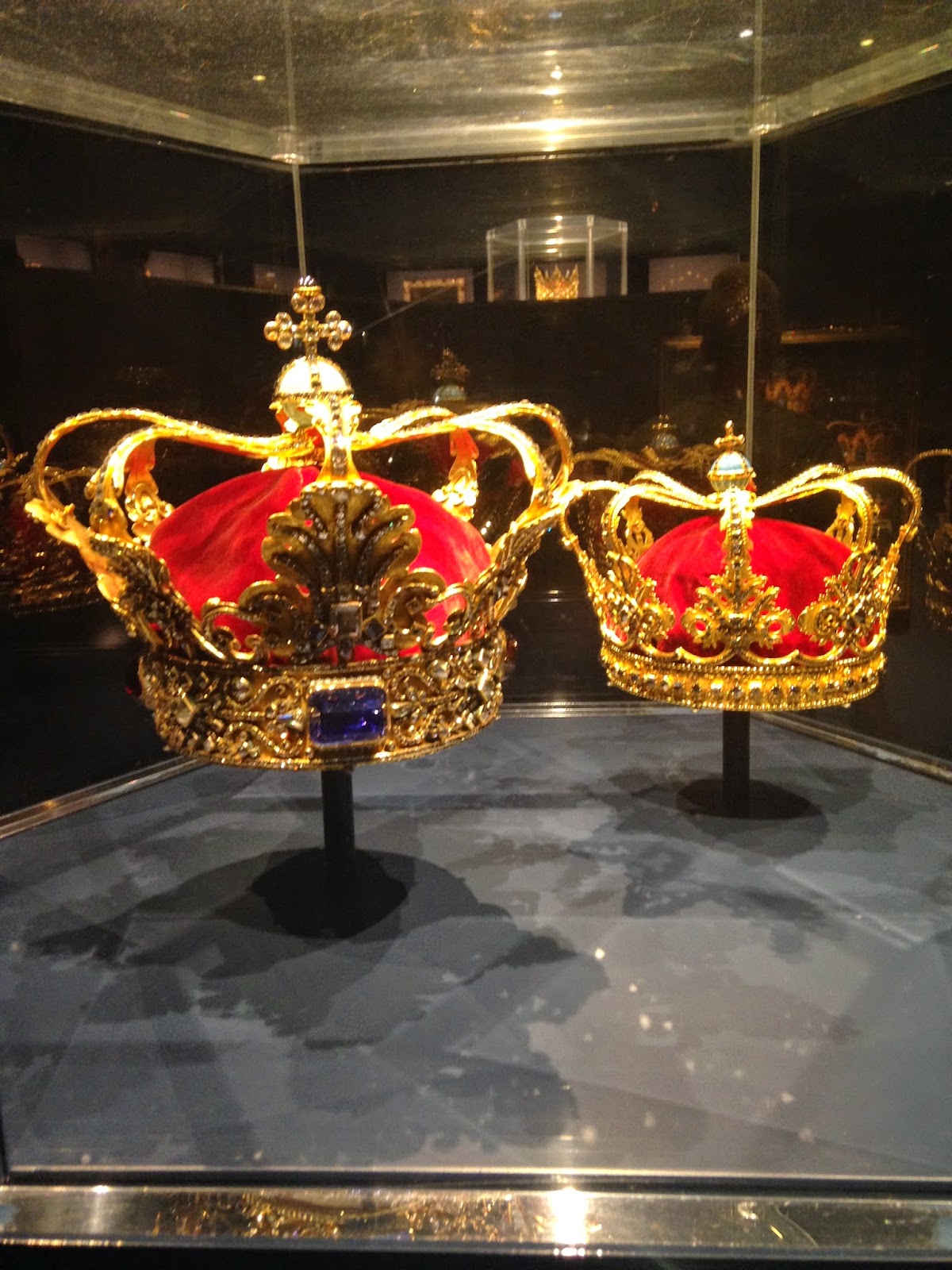
We continued the tradition of visiting the Royal Palace in each city; tickets also allowed us access to the treasury, so we could see various crowns and royal jewels.


Another memorable quality of Copenhagen was the very high number of street performances and demonstrations. Furthermore, the performers tries to gleam as much money as possible from the audience. Nevertheless, the performances were amusing, and often we did give them money. 
Below you will find a guy about to juggle a torch, a club, and a knife-blindfolded on top of a sculpture he designed.


My personal favorite was a "headless" guy playing guitar.


Copenhagen is also the birthplace of the great Hans Christian Anderson (author the "The Little Mermaid," "The Ice Queen"-inspiration for Frozen, and many more children's stories.
As a result, a Little Mermaid Statue was donated to the city and is now one of the major icons of Copenhagen (semi-NSFW).


On our last day in Copenhagen, we decided to have breakfast at one of Copenhagen's most highly rated cafés, Cafe Paludan. This was by far the best meal we had all trip, and everyone concluded if you only go to one place in Copenhagen, it is this cafe.

Below is the picture of the meal, which consisted of watermelon, parfait, pancakes, Brie cheese, eggs with sundried tomatoes, cantaloupe, syrup, oranges, hummus,and a fruit loosely translated as a "pineapple cherry." Also included was a strawberry smoothie, to top it all off.

With the last few hours of our time in Cooenhagen, we decided to visit an area where trampolines are implanted into the sidewalks, and we happily bounced around on them.


Amsterdam

While Norway, Sweden, and Denmark all have similar cultures (each was distinct, but the language and history overlaps frequently), Amsterdam was completely different. Once we figured out how to navigate the Metro system and mistakenly took the wrong train twice, we finally made it to our hostel. 

Our first impression was the insanely high number of bikes outside the Metro. There must have been 1000 bikes stationed there. We would soon come to learn that transportation in Amsterdam was unlike anything I had ever seen before....

Transportation in Amsterdam would entail  all sorts of vehicles, most of which could ride on the sidewalks. There were bikes, mopeds, motorcycles, trams, cars, horse-drawn carriages, and you had to constantly be on the lookout for everything at all times. We got around primarily on the tram, but most of us were nearly hit by some type of vehicle at one time or another.


The hostel we stayed in was extremely sketchy, and it didn't help that it was 90+ degrees outside and the hostel didn't have air conditioning. In order to get into the hostel, you have to go up a flight of 50 steep steps to get into the lobby, and another 25 to get into your room.

Upon making it up to the lobby the first time, the hotel manager told us the rules, including: "Smoking weed is only allowed on the stairwell." As any normal person would do, we asked him where one would get weed. He informed us that coffee shops everywhere sell weed, and obviously it is legal in Netherlands. 

 Nevertheless, we were there to see sights, not partake in that type of tourism, but it was definitely a presence throughout the city. Coffee shops can be found on every block, and ID has to be shown to enter. 

The architecture of Amsterdam is remarkably different than Scandinavia, evidenced by the picture below.


We loved the sculptures in Amsterdam, and especially the city center. You could climb on the letters, and we definitely had a lot of fun taking pictures there. This one in particular is iconic for the city:


We purchased tickets to go into Amsterdam's National Museum and a Canal Tour for the first day, so those would be our first stops.

The National Museum contained portraits from Van Gogh, Renbrandt, and other famous artists. It also contained some modern Dutch art, such as an airplane and random colors on a canvas.


The Canal tour was quite good, and gave us some great information about the city. The guide explained that some of the houses are crooked/tilted because of the water level fluctuations. Also, he informed us that the entire canal is emptied every two weeks and replaced with new water, ensuring that the water is fresh, and available to drink or swim if you desire.


Amsterdam also was filled with amusing street performances, such as a guy spinning on his bare head for a duration of at least 5 minutes, speeding up and down.


In addition to weed being legal in the country, we learned and saw firsthand many other things are also legal in Netherlands that are illegal in the USA.

1.  Same sex marriage was legalized in the Netherlands in 2001 as long as either the bride or groom is a Dutch citizen. 

2. Prostitution is legal in Netherlands, and is regulated in the city's Red Light district. You can walk down alleys and see prostitutes in windows available, but you have to be careful of pickpockets there. They cleverly wait for wanderers to get distracted by the ladies and wallets have been known to be stolen there.

3. Drinking at Age 16. This is also the drinking age in Denmark, but alcohol does not nearly carry the social stigma that it has in the United States. Weed is often allowed in bars, too.


Anyways, we also got the chance to visit the Anne Frank House (the house where she hid during during WWII), now turned into a museum. This rivaled the Nobel Prize Museum for our favorite museum; it was so moving and powerful that we all felt very emotional and taken by it. No pictures allowed in there for preservation purposes, but it had many quotations by Anne Frank and featured photographs and information that could only be found at the House. 


We also visited the Amsterdam Royal Palace, and we thought it was really interesting how far back the Dutch lineage really goes, and that Netherlands really played such a significant role in trading for hundreds of years. They were essentially the world superpower until the British came along, and then later, America. 

We also noticed that Amsterdam was in mourning for the victims of the plane tragedy, and there were flowers and a whole ceremony outside of the Amsterdam airport.

Well, I know this has been a very long blog post, but I think it covered most of the sights in all of these cities. We very much enjoyed traveling and exploring Scandanavia and Amsterdam, and learned even more about the culture of each of the cities!